There are no items in your cart
Add More
Add More
| Item Details | Price | ||
|---|---|---|---|
Fri Oct 16, 2026
You have submitted your resume, received an interview invitation, and prepared for questions related to your education and technical knowledge. Now comes another important stage: the HR interview.
For many freshers, this round creates a different kind of nervousness.
You may wonder how to explain your strengths, what to say about your weaknesses, how to answer salary questions, or how to respond when the interviewer asks why the company should hire you.
The good news is that you can prepare for many common HR questions before entering the interview room.
The goal is to understand what the interviewer wants to learn about you and respond with clear, honest, relevant examples.
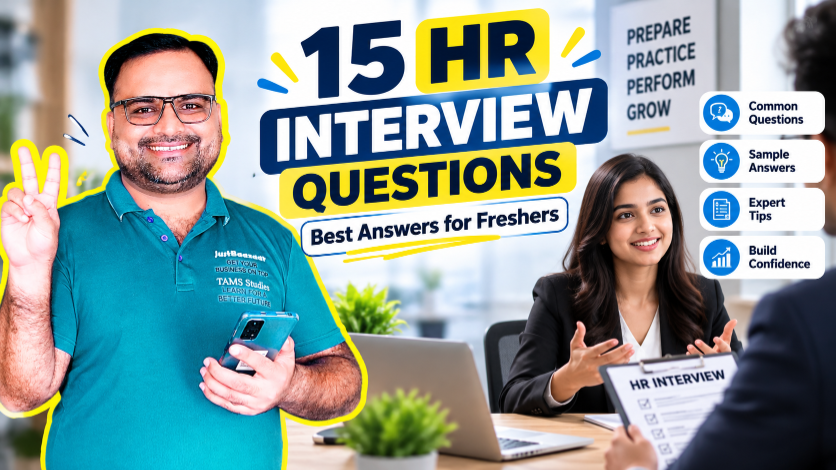
In this guide, I will explain 15 common HR interview questions, provide sample answers for freshers, and share practical tips for adapting those answers to your own background.
An HR interview is a conversation that helps an employer understand your background, communication, professional expectations, motivation, and suitability for the organization.
Depending on the company and role, the HR round may cover:
Not every employer asks all these questions. Some companies combine HR and technical discussions, while others conduct separate interview rounds.
Prepare for the questions most relevant to the job you are pursuing.
Before reviewing the 15 questions, remember these five principles.
Do not invent experience, qualifications, or achievements. If you do not know something, acknowledge it and explain what you are doing to improve.
Whenever possible, support your answers with examples from your education, projects, internships, volunteering, or work experience.
Answer the question directly. You can add context, but avoid long explanations that move away from the topic.
You do not need complicated English to communicate professionally. Use sentences you understand and can speak comfortably.
Use the sample answers below as frameworks. Replace the examples with your actual experiences, interests, and career goals.
Why HR asks this: The interviewer wants a concise overview of your background and professional direction.
How to answer: Mention your education, relevant skills, a project or practical learning experience, and your interest in the position.
“Good morning. My name is [Your Name], and I have completed my [Qualification] from [Institution Name]. During my studies, I developed an interest in [Relevant Field] and worked on improving my skills in [Skill One] and [Skill Two]. I have also worked on [Relevant Project or Activity], which helped me understand some practical aspects of the subject. I am now looking for an opportunity where I can apply my knowledge, learn from experienced professionals, and contribute to the organization's work.”
Keep your introduction concise, usually around one minute to start with. Adapt the length to the interviewer's cues.
For more examples, read our related guide on answering common interview questions through the Career Building School learning resources.
Why HR asks this: The interviewer wants to understand whether you have researched the organization and considered the opportunity seriously.
How to answer: Connect something relevant about the company or role with your interests and professional goals.
“I am interested in joining your company because this position aligns with my skills and career interests. I have reviewed the role and understand that it involves [Relevant Responsibility]. I would like to apply what I have learned, gain practical experience, and contribute to the team's objectives. I also see this as an opportunity to develop professionally in this field.”
Before the interview, research the company's products or services, customers, industry, and the responsibilities listed in the vacancy.
Avoid saying that you want to join only because the company is famous or because you need any job available.
Why HR asks this: The interviewer wants to understand what you could bring to the position.
How to answer: Highlight two or three relevant strengths and connect them to the job requirements.
“As a fresher, I am at the beginning of my professional journey, but I have been working to develop relevant skills through my education and practical learning. I am willing to learn, take feedback seriously, and approach my responsibilities with care. I believe my interest in this field and my commitment to improving my abilities would help me contribute while learning from the team.”
Do not claim that you are better than every other candidate. Explain why your current abilities and attitude are relevant to the role.
Why HR asks this: The interviewer wants to understand which personal or professional qualities you can bring to the workplace.
How to answer: Select strengths relevant to the job and support them with a genuine example.
Possible strengths include:
“One of my strengths is that I am willing to learn and improve. When I encounter a topic I do not understand, I try to break it into smaller parts, study the fundamentals, and practise until I understand it better. I believe this approach can help me adapt to new responsibilities.”
Choose a strength you can genuinely demonstrate. If possible, prepare a real example from an academic assignment, project, or other experience.
Why HR asks this: The interviewer may want to understand your self-awareness and willingness to improve.
How to answer: Identify a genuine, manageable area for development and explain the steps you are taking to improve.
“I am working on improving my confidence when speaking in unfamiliar professional situations. To improve, I practise introducing myself, explaining my projects aloud, and preparing for likely questions before important conversations. I am gradually becoming more comfortable through regular practice.”
Use this example only if it reflects your situation.
Avoid claiming that you have no weaknesses. Also avoid presenting a serious, job-critical limitation without explaining how you are addressing it.
Why HR asks this: The interviewer may want to understand your professional direction and expectations for growth.
How to answer: Explain that you want to develop relevant expertise, gain experience, and take on greater responsibility as your abilities grow.
“Over the next five years, I would like to build strong practical knowledge in my field, become more confident in handling responsibilities, and continue developing my professional skills. I hope to take on more complex work as I gain experience and contribute meaningfully to the team.”
You do not need to predict your exact job title five years from now. Offer a realistic direction that connects with the position.
Why HR asks this: The interviewer may be exploring your understanding of your current capabilities and what you can offer at an entry level.
How to answer: Recognize that experienced candidates bring valuable knowledge, then explain your own relevant strengths without comparing yourself unfairly with others.
“Experienced candidates bring valuable practical knowledge, and I respect that. As a fresher, I can offer a willingness to learn, an interest in developing the skills required for this role, and a fresh perspective from my recent education. I am prepared to take feedback, follow established processes, and work consistently to become more effective in the position.”
Support your answer with relevant projects, skills, or examples where possible.
Why HR asks this: The interviewer wants to understand whether your expectations are broadly compatible with the role and the employer's compensation range.
How to answer: Research the position, industry, location, and experience level before the interview. Consider the responsibilities and the overall compensation package.
“As a fresher, my priority is to find a role where I can apply my skills and develop professionally. I am open to discussing compensation in line with the responsibilities of the position and the company's salary structure. I would also be interested in understanding the overall package and benefits.”
If the employer asks for a specific range, provide a realistic range based on your research and circumstances rather than assuming that you must accept any amount.
You can also ask about the budgeted range if the interviewer has not provided it.
Why HR asks this: The interviewer needs to understand whether your availability matches the role's location and schedule requirements.
How to answer: Be clear about what you can genuinely accept.
“I am open to discussing relocation and working arrangements, depending on the role's requirements and the practical details. I would appreciate understanding the expected location, schedule, and any relocation support available.”
If you have limitations, explain them respectfully. Do not promise relocation, night shifts, or a particular schedule unless you can realistically manage those requirements.
Why HR asks this: Most workplaces require employees to coordinate with other people. The interviewer may want to understand how you communicate and contribute to shared tasks.
How to answer: Explain how you work with others and provide a genuine example where possible.
“Yes, I am comfortable working in a team. I believe good teamwork requires clear communication, respect for different perspectives, and responsibility for assigned tasks. During [Academic Project or Activity], I worked with others to [Actual Contribution]. That experience helped me understand the importance of coordination and completing my part of the work.”
Use an example from a group assignment, student activity, internship, or work experience if available.
Why HR asks this: The interviewer wants to understand how you organize tasks and respond when several responsibilities require attention.
How to answer: Describe a practical approach rather than simply claiming that you work well under every kind of pressure.
“When I have multiple tasks, I first identify the deadlines and the importance of each task. I break larger tasks into manageable steps and organize my time accordingly. If I see that a deadline may be difficult to meet, I would communicate the issue early and discuss the next steps with the relevant person.”
If you have an example of managing deadlines during your studies or projects, use it to make the answer more credible.
Why HR asks this: The interviewer may want to understand your problem-solving approach, persistence, and ability to learn from experience.
How to answer: Use a simple structure: situation, task, action, and result or learning. This is often called the STAR method.
“During [Project or Activity], I faced a challenge involving [Specific Problem]. My responsibility was to [Task]. I approached it by [Actions You Actually Took]. As a result, [Actual Outcome or Learning]. The experience taught me the importance of [Relevant Lesson].”
Choose a real example. You do not need a dramatic story; a small but meaningful challenge can demonstrate how you think.
Why HR asks this: The interviewer may want to understand what encourages you to learn, contribute, and continue working toward goals.
How to answer: Explain what genuinely interests you about your work and connect it to the role where possible.
“I am motivated by learning new things and seeing improvement in my abilities. I enjoy understanding a problem, working through it, and discovering a better way to complete a task. I would like to work in an environment where I can continue developing these skills and contribute to meaningful objectives.”
Your motivation might also involve solving customer problems, analysing information, creating useful content, or supporting a team. Choose what genuinely fits you.
Why HR asks this: The interviewer may want to give you an opportunity to clarify details about the position and understand your level of interest.
How to answer: Prepare one or two thoughtful questions related to the job.
For example:
Choose questions that have not already been answered during the interview.
If you have no additional questions, you can politely say that the discussion has clarified your main concerns and thank the interviewer for the information.
Why HR asks this: The employer wants to understand your availability and whether it matches the organization's hiring timeline.
How to answer: State your actual availability and mention any academic, contractual, or other commitments that affect your joining date.
“I am available to join from [Date], subject to completing any required documentation and formalities. I would be happy to discuss the joining timeline based on the company's requirements.”
If you need time to complete examinations, relocation, or other commitments, explain your situation clearly.
Never promise an immediate joining date if you cannot realistically meet it.
Reading sample answers is a useful first step, but speaking your answers aloud is what helps you become more comfortable with the interview format.
Try the following preparation routine.
Review your resume, educational background, projects, skills, and career goals. Make sure you can explain each item accurately.
Do not write a long speech for every question. Note the main ideas and examples you want to communicate.
Answer the questions aloud. Use simple language and focus on answering the question directly.
Ask a friend to ask you questions in a random order. This helps you practise responding naturally instead of relying on a fixed sequence.
Notice where you repeat yourself, give unclear examples, or speak too quickly. Practise those areas again.
Write key points for the 15 questions. Personalize your introduction, strengths, weaknesses, career goals, and examples from your own experience.
Practise answering aloud. Review your resume, revise relevant subject knowledge, and prepare for questions specific to the job.
Conduct a mock interview, check your clothing and documents, confirm the interview time, and plan your travel or online setup.
Adjust the plan to the time available. If your interview is tomorrow, prioritize the job description, your introduction, resume-related questions, and the most relevant HR questions.
An HR interview is not a competition to see who can memorize the most impressive sentences. It is an opportunity to explain who you are professionally, what you can offer, and how you approach learning and work.
Preparing for an HR interview becomes easier when you understand the purpose behind each question.
Prepare your introduction, identify your genuine strengths, think about areas you are improving, and practise explaining your experiences. Research the company, understand the job, and be ready to discuss practical details such as availability and compensation.
You do not need to pretend to be an experienced professional when you are a fresher. You need to present your current abilities honestly and demonstrate that you are prepared to develop further.
Prepare thoughtfully, communicate clearly, and use every interview as an opportunity to learn.
Explore Career Building School's learning resources to continue developing practical digital and professional skills that can support your career preparation.
Explore Career Building SchoolCommon questions include “Tell me about yourself,” “Why should we hire you?”, “What are your strengths and weaknesses?”, “Why do you want to join our company?”, and questions about salary, availability, and career goals.
Review the job description, research the company, prepare your introduction, practise common questions, review your resume, and think of genuine examples from your education or projects.
It depends on the question. Many straightforward answers can be delivered in 30–90 seconds, while experience-based questions may need a little longer. Keep your response relevant and follow the interviewer's cues.
Choose a genuine area for improvement and explain the steps you are taking to address it. Avoid pretending that you have no weaknesses or choosing an answer that is unrelated to your actual experience.
Use simple sentences, practise aloud, and focus on clear communication. Prepare the main points of your answers rather than memorizing complicated scripts.
Use relevant academic projects, internships, personal projects, volunteering, or learning activities as examples. Be clear about what you did and what you learned.
Research the role and market, consider the responsibilities and overall package, and provide a realistic expectation if asked. You can also ask about the employer's budgeted range.
You may ask about the role's responsibilities, onboarding, training, performance expectations, or next steps in the hiring process. Choose questions that have not already been answered.
It is better to understand the structure and practise your main points. Memorizing every word can make your responses sound unnatural and harder to adapt to follow-up questions.
No. The hiring decision depends on the employer's requirements, other candidates, your qualifications, and the overall selection process. Good preparation can help you communicate your suitability more clearly, but it cannot guarantee selection.
Prepare well, stay genuine, and keep building the skills that support your professional journey.
 Launch your Graphy