There are no items in your cart
Add More
Add More
| Item Details | Price | ||
|---|---|---|---|
Wed Oct 14, 2026
Receiving your first job interview invitation is an exciting moment.
You may feel happy that your application has been noticed, but a few minutes later, questions start appearing in your mind.
What will the interviewer ask? How should you introduce yourself? What if you forget an answer? What if your English is not fluent? What if you do not have any professional experience?
These concerns are common, especially when you are entering the job market for the first time.
You do not need to become a perfect candidate overnight. You need to prepare thoughtfully and present yourself honestly.
Your first interview is not just an opportunity for an employer to evaluate you. It is also an opportunity for you to understand the role, the organization, and the expectations of the workplace.
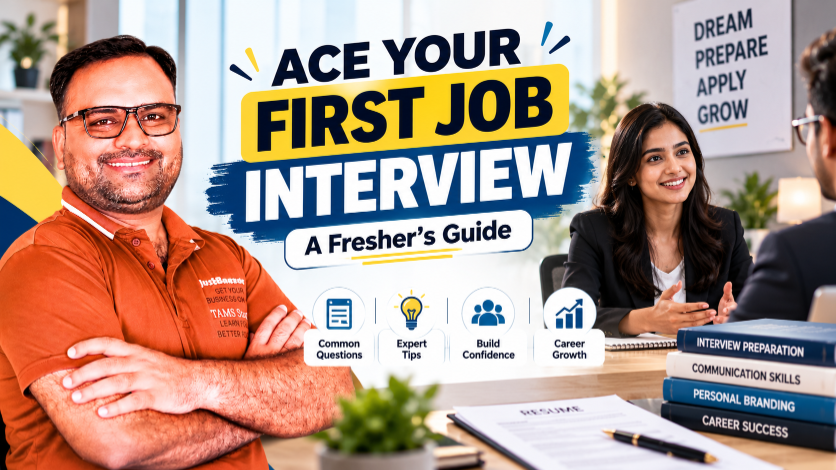
In this guide, I will explain how to prepare for your first job interview, answer common questions, handle difficult moments, communicate confidently, and avoid mistakes that can weaken an otherwise good interview.
A resume tells an employer about your education, skills, and experience. An interview allows the employer to ask questions, understand your thinking, and explore how your background relates to the role.
Depending on the position, an interviewer may assess:
The interview format differs across companies. Some interviews focus on technical knowledge, while others include behavioural questions, practical tasks, group discussions, or multiple rounds.
That is why your preparation should begin with the role itself rather than a random list of interview questions.
Before preparing answers, read the job description carefully.
Many candidates spend hours learning general interview questions but overlook the actual responsibilities of the job.
Start by identifying:
Then ask yourself which parts of your background match these requirements.
For example, if you are applying for a digital marketing position, you may need to prepare for questions about SEO, social media, content planning, online advertising, or analytics.
If you are applying for a finance position, you may need to revise accounting fundamentals, Excel, financial concepts, or the specific responsibilities listed in the vacancy.
Your preparation should match the job you want.
Do not enter an interview without knowing what the company does.
Spend time exploring its official website and other relevant public information.
Try to understand:
You do not need to memorize the entire company history.
You should simply be able to explain why the opportunity interests you and how the role connects to your career direction.
“Tell me about yourself” is a common interview-opening question.
Many freshers make one of two mistakes: they either provide too little information or tell their entire life story.
A useful introduction should be brief, relevant, and easy to follow.
Use this structure:
“Good morning. Thank you for giving me this opportunity. I have completed my education in [your qualification] and have been developing my skills in [relevant field]. I have worked on [relevant project or learning activity], which helped me understand some practical aspects of the subject. I am now looking for an opportunity where I can apply my knowledge, learn from an experienced team, and grow professionally.”
Replace the placeholders with your actual details.
Do not memorize the introduction word for word. Understand the structure and practise speaking naturally.
You cannot predict every question, but you can prepare for several common themes.
The interviewer wants to understand your motivation and whether you have considered the role seriously.
Avoid giving only a generic answer such as “I need a job.”
Explain how the position relates to your skills, interests, and professional goals.
“I am interested in this role because it aligns with my interest in [relevant area]. I would like to apply the knowledge I have developed, gain practical experience, and contribute to the team's work while continuing to learn.”
You do not need to claim that you are better than every other candidate.
Focus on the relevant qualities you can bring.
“I am at the beginning of my career, but I have been taking practical steps to build relevant skills. I am willing to learn, take feedback seriously, and work responsibly. I believe this opportunity would allow me to contribute while continuing to develop professionally.”
Choose one or two genuine strengths that relate to the role.
Examples may include attention to detail, curiosity, communication, analytical thinking, consistency, or willingness to learn.
Support your answer with a short example whenever possible.
Choose a genuine area for improvement and explain what you are doing about it.
For example, you might explain that you are working on organizing your time more effectively by setting priorities and reviewing deadlines.
Avoid pretending that you have no weaknesses.
Give a realistic answer that shows direction without promising an unrealistic career path.
“I want to build a strong foundation in my field, gain practical experience, and gradually take responsibility for more complex work. I would like to continue learning and become someone the team can rely on.”
Your resume is one of the most useful interview preparation documents you have.
If you mention a skill, certification, project, internship, or achievement, be ready to discuss it.
An interviewer might ask:
Review your resume line by line before the interview.
If you have listed a skill that you only understand at a basic level, be honest about your proficiency.
It is better to explain your current understanding clearly than to claim expertise and struggle with a follow-up question.
Freshers sometimes believe they have nothing to discuss because they have not held a full-time job.
That is not necessarily true.
You may be able to discuss academic assignments, independent projects, internships, volunteering, or practice projects relevant to the role.
Use this structure to explain a project:
If you have genuine results, describe them accurately. If the project was hypothetical, say so.
Do not invent clients, revenue figures, or professional experience to impress an interviewer.
Reading interview answers silently is not enough.
You need to practise saying them aloud.
Try the following routine:
You do not need to use complicated vocabulary to sound professional.
Clear sentences, relevant examples, and a calm speaking pace are often more useful than trying to impress someone with difficult words.
Do not allow this concern to stop you from preparing.
Your language requirements will depend on the role and employer, but you can improve your interview communication through regular practice.
Start with:
If you need a moment to think during an interview, you can politely say:
“May I take a moment to think about that?”
Then organize your thoughts before answering.
Do not confuse fluent English with complete professional ability. Work on communicating clearly while continuing to strengthen your subject knowledge.
Technical preparation depends on the position you are applying for.
For a digital marketing role, revise topics such as:
For a finance role, review the concepts and tools mentioned in the job description.
For a customer service or sales role, practise explaining how you would understand customer needs, handle objections, communicate professionally, and solve problems.
Do not try to learn every topic in your industry immediately before the interview.
Prioritize the concepts most relevant to the role and practise explaining them in your own words.
Some interviewers want to understand how you would respond to a realistic work situation.
For example:
A useful way to structure your answer is:
You do not need to pretend you have already faced every situation. Explain how you would approach it responsibly.
Preparation includes practical arrangements, not only interview answers.
For an in-person interview:
For an online interview:
These small steps can reduce avoidable stress on the day.
You do not need to perform a complicated routine to appear professional.
Focus on basic courtesy and attentiveness.
For online interviews, look toward the camera when appropriate and avoid distractions from your phone or other applications.
Professionalism is demonstrated through your overall behaviour, not one particular gesture.
You will not know the answer to every possible question, and that is normal.
The mistake is pretending to know something when you do not.
Instead, acknowledge the gap and explain what you understand.
Example response:
“I have not worked with that particular tool yet, so I do not want to give you an inaccurate answer. My current understanding is [brief explanation]. I would be interested in learning how it is used in practice.”
If you know part of the answer, explain that part clearly.
Do not turn every difficult question into a long explanation about why you do not know it. Stay calm and move forward.
At the end of the interview, you may be asked whether you have any questions.
Prepare one or two questions that genuinely help you understand the opportunity.
For example:
Choose questions that have not already been answered during the interview.
You can also ask about the next steps in the hiring process.
Your preparation does not end when you leave the room or close the video call.
After the interview:
If you do not receive an immediate response, avoid sending repeated messages. Follow the employer's stated timeline where one has been provided.
If you are not selected, review what you learned and improve your preparation for the next interview.
Read the job description and research the employer. Identify the most important skills and responsibilities.
Write a short introduction and practise speaking it aloud. Prepare answers about your education and career interests.
Review the subject knowledge most relevant to the position. Focus on understanding concepts rather than memorizing definitions.
Review every section of your resume. Practise explaining your strongest project, internship, or academic work.
Prepare for questions about strengths, weaknesses, motivation, teamwork, and career goals.
Ask a friend to interview you or record yourself answering questions. Review your clarity, relevance, and speaking pace.
Check your documents, clothing, route or online setup, and interview time. Review your notes without trying to learn everything at the last minute.
It is about understanding your own background, knowing the relevant fundamentals, and being ready to communicate clearly when questions arise.
Memorized answers can sound unnatural and become difficult to adapt when the interviewer asks a follow-up question.
Answer the question directly, then provide an example or explanation where useful.
Be honest about your level of experience and your current capabilities.
Discuss difficult experiences professionally without unnecessary criticism of previous employers, teachers, or colleagues.
General interview preparation cannot replace understanding the specific role.
If you do not understand a question, politely ask the interviewer to explain or repeat it.
A rejection can be disappointing, but it is not a complete judgment of your potential. Review your preparation and continue improving.
Confidence is not the absence of nervousness.
You can feel nervous and still communicate effectively.
Build confidence through preparation rather than waiting until you feel completely ready.
Start with manageable actions:
Do not compare your beginning with someone else's years of experience.
Focus on presenting your current abilities honestly and showing that you can learn.
Your first job interview may feel like a major test, but it is also a valuable learning experience.
You do not need to know everything. You need to understand the role, prepare your examples, revise the relevant fundamentals, and communicate professionally.
As a fresher, your education and projects can provide a starting point. Your willingness to learn, take feedback, and approach problems responsibly can also help the interviewer understand your potential.
Prepare seriously, but do not put unnecessary pressure on yourself to deliver a perfect performance.
Know your background. Understand the role. Practise your answers. Be honest about your abilities. Keep improving after every interview.
Explore Career Building School's learning resources to develop practical skills that support your professional development and help you prepare for new career opportunities.
Explore Career Building SchoolUnderstand the job description, research the company, prepare your introduction, revise relevant fundamentals, review your resume, practise common questions, and prepare thoughtful questions for the interviewer.
Common questions include “Tell me about yourself,” “Why do you want this job?”, “What are your strengths?”, “What is your weakness?”, and “Why should we hire you?” Role-specific questions vary by employer.
A concise introduction of around one minute is a useful starting point. Cover your background, relevant skills, a project or learning experience, and your interest in the role. Adjust the length to the interviewer's question.
Be honest, explain what you do understand, and avoid inventing information. If the question is unclear, politely ask for clarification.
That depends partly on the role's communication requirements. Practise simple, clear answers, learn relevant professional vocabulary, and prepare examples from your own experience. You do not need complicated sentences to communicate clearly.
Connect your relevant skills, preparation, projects, and willingness to learn to the role. Support your answer with genuine examples rather than making exaggerated claims.
Bring your resume and any documents requested by the employer. Keep relevant portfolio links or project examples ready. For an online interview, test your equipment and internet connection beforehand.
Yes, when invited and when you have a genuine question. You can ask about the role's priorities, team responsibilities, learning opportunities, or the next stage of the hiring process.
Thank the interviewer, follow up politely if appropriate, note the questions that challenged you, and continue applying for suitable opportunities while you wait for a decision.
Practise aloud, conduct mock interviews, revise relevant concepts, prepare examples, and review your performance after each attempt. Confidence can improve as you gain experience.
Your first interview is a starting point. Prepare well, communicate honestly, and use every experience to become better.
 Launch your Graphy